
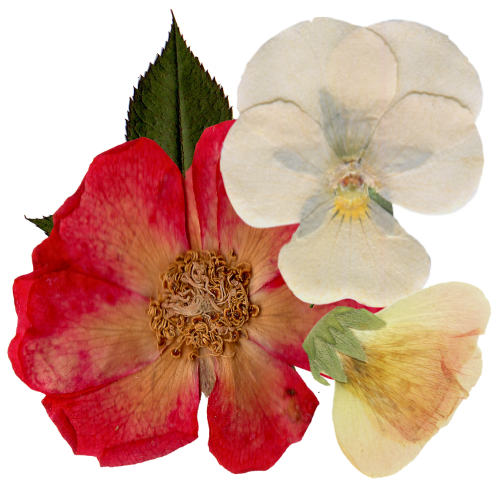


Flowers, also known as blossoms and blooms, are the reproductive structures of flowering plants. Typically, they are structured in four circular levels around the end of a stalk. These include: sepals, which are modified leaves that support the flower; petals, often designed to attract pollinators; male stamens, where pollen is presented; and female gynoecia, where pollen is received and its movement is facilitated to the egg. When flowers are arranged in a group, they are known collectively as an inflorescence.

Petals
The petals, collectively called the corolla, are almost or completely fibreless leaf-like structures that form the innermost whorl of the perianth. They are often delicate and thin and are usually coloured, shaped, or scented, to encourage and facilitate pollination.The petals may be fused together. Petals also tend to have patterns only visible under ultraviolet light, which is visible to pollinators but not to humans. In some flowers, petals and sepals are indistinguishable from one another.
Emerson and Flowers
The American radical individualist philosopher and abolitionist Ralph Waldo Emerson (1803-1882) in his essay on “Gifts” which he published in 1844 asks himself what is the best gift to give during the Christmas and New Year period. He begins by asking what is the most appropriate gift to give in a time of high public and private indebtedness when the “world is in a state of bankruptcy”.

His answer is twofold. His first recommendation is not surprising given his views on nature: the gift should be a simple one such as flowers because “they are a proud assertion that a ray of beauty outvalues all the utilities of the world” or fruits because “they are the flower of commodities, and admit of fantastic values being attached to them.”
“The earth laughs in flowers.”
― Ralph Waldo Emerson
The second recommendation reflects his individualist philosophy of transcendentalism, that is one should give something that reveals an aspect of the giver as a person, or as he phrased it “when a man’s biography is conveyed in his gift.” So a poet gives a poem, a shepherd a lamb, and so on.